Two non-profits,
Global Exchange and
Green America (formerly Co-op America), hosted the eighth annual
Green Festival in San Francisco on the weekend of November 13-15, 2009, at San Francisco's Concourse Exhibition Center. But just how 'green' was this event? Perhaps that depends on how you define 'green'.
 Green?
 For example, are plug-in cars really 'green'? Or do they just make us feel 'green'?
 Woody Hastings, Seeker ...
 Woody Hastings, the husband of one of the people who has been integrally involved in Global Exchange for years, stopped to talk to me about the event when we ran into each other.
"We're seekers," he said. "This is where the envelope is pushed on sustainability and where the conversation is happening. It's not happening at the United States Chamber of Commerce," an organization which is widely perceived to be
obstructing legislative action on curbing greenhouse gas emissions.
The event had started in 2003 with the intent of bringing together like-minded people who were and are concerned about the planet, knowing that we can't go on, business as usual.
"It's ground zero of sustainability and social justice," he said, adding that the products that are marketed at the event are reusable and made from sustainably-harvested natural resources.
So, I set out to explore ...
 How many bicycles can fit into one car parking space?
How many bicycles can fit into 10 car parking spaces?
Do what extent does valet bicycle parking draw people to events versus how many car parking spaces draw people (and their wallets) to events?
The
San Francisco Bicycle Coalition, as it always does, had free valet bicycle parking. Considering the rate of bicycle theft and vandalism in this city (at a recent event in Golden Gate Park in which there was no bicycle parking, someone stole my water bottle ...), secure bicycle parking is a really important amenity if you want to encourage people to ride their bicycles more often.

And inside, three sets of bins for waste could be found throughout the event, black for garbage, green for compost, and blue for recycling. People staffed most bins helping people sort their waste correctly.
An obsession with recycling and compost is almost genetic in my family -- one of my sisters is the recycling coordinator in her Massachusetts town, and when she and her family visited last year, she took photographs of bins out on the sidewalks and did everything she could to convince her daughters and husband to go with her to the SF Dept. of the Environment (to no avail).

Here, an exhibitor demonstrates proper disposal of paper cups for me -- they go into the composting bin.
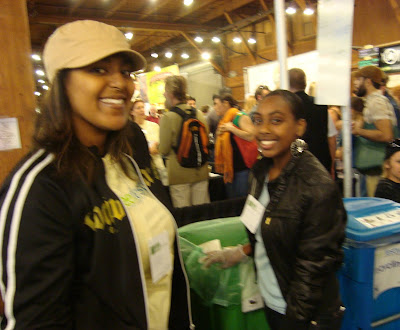
I told these two volunteers that I wanted to volunteer at the bins next year, and they immediately -- and in unison -- said, "No, you don't ... ." Still, they had lovely smiles. But why were they so convinced it was a bad job? Perhaps because ...

... despite all the help, visitors still couldn't get it right. If you look closely, you can see small clear cups inside this black bin. The clear cups were not made from plastic. They were made from something compostable and should have been in the green compost bin.

And the papers cups and plastic cups in this bin should also have been in the green bin, and packaging that was clearly garbage had been thrown into the black bin, and ...

.. outside, people hauled bags out of the bins non-stop. Still, I looked at this operation out back and was impressed and energized. I think I'll sign up for this next year.

I once stumbled upon this surprisingly empty passageway, and wondered why there were so few people mingling in front of the booths. And then I looked at the banners in the booths:
capitalism ... Aren't we done with that system yet?

Obviously not -- one of the
Democracy Now! headlines from November 18, 2009 read that Wall Street is headed for record profits in 2009, which just boggles the mind considering the unemployment rate and the ongoing fallout from the last three Reaganesque decades of deregulation. Still, people were not flocking to these booths. I think that's because this event is really a rejection of the system that brought us to the edge of the financial abyss that we now teeter on. And I think the speakers underscored that.
In previous years, a space had been cleared in the long main hall for speakers, a tent had been erected outside next to the Concourse, or the event organizers had rented the pavillion across the street. This year, one end of the interior of the building was cleared out for speakers -- a space that seemed smaller than in years past. I don't know if it really was, but everything about the event seemed less bustling than in past years -- perhaps a reflection of the economy.

Here, Ocean Robbins, introduces his father,
John Robbins, heir to the Baskin-Robbins ice-cream fortune who turned his back on the family business in order to seek a life of greater meaning -- and a better diet.
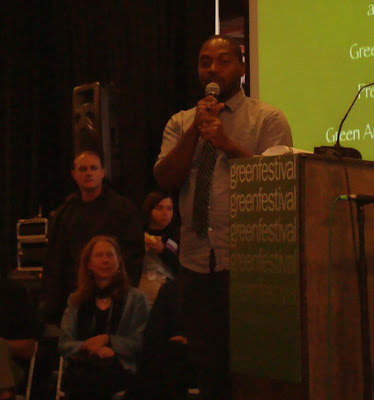
Bryant Terry also introduced John Robbins. Terry got turned onto veganism in the early 1990s when he first read
Diet for a Small Planet by Frances Moore Lappe. He said that at that time he became a hell-on-wheels self-righteous proselytizer for veganism. He has since come out with his own book,
Grub: Ideas for an Urban Organic Kitchen.
 John Robbins, author of The Food Revolution, Reclaiming Our Health, Diet for a New America, and The Awakened Heart among other writings.
 Alisa Gravitz, founder of
Co-op America/Green America, presents Robbins with an award made out of recycled glass and sustainably-farmed wood. On it is this quote: "It is the love in our hearts that underlies and makes possible our greatest healing."
"It is imperative that we enlarge our sense of what's possible ... and [work] to transform what has been an insane cultural disease," he said. I guess he was referring to western consumption patterns at the expense of global ecological balance and personal physical and mental well-being.
And, "The purpose of life ... infinite gratitude to all things past, infinite service to the present, and infinite responsibility to the future ..." You can fill in the dots with words that will express the intent of this partial quote.
I was taking notes furiously, as I always do, but did not catch everything. No matter, I caught his drift.
"Pain ... we're here to feel those things so that it can awaken within us ... [thoughts] about career choices [and shifts in] consciousness ... [so that we can] transform the way we relate to money."
Ok, I'll admit, I'm not sure I have conveyed the exact meaning of what he was saying, but I sure can tell you this: I have conveyed the vague sense of what I am experiencing and feeling as I head into one more year of underemployment and the belief that this current recession -- and the looming resource shortages and ecological crises that confront us -- is going to change the world and the way people live on it forever. And the belief that we have to adapt to these changes -- and do so enthusiastically and with the joy of discovering knew challenges -- or we are doomed.
 Amy Goodman
 The featured speaker, as it is every year, was
Amy Goodman, co-anchor with Juan Gonzalez of the show,
Democracy Now!, a public radio alternative to
All Things Considered and
Morning Edition. Her newest book is
Breaking the Sound Barrier, and that was the theme of her talk this year.
 Trickle Up Everything
 As she had in years past, she extolled the independent media and exhorted audience members to go out and produce public access television shows (a difficulty this year in San Francisco because the public access station has been largely defunded), noting that by chance, the first television broadcast of Democracy Now! happened at a public access station in New York City -- on September 11, 2001.
Pacifica Radio, the national station that is linked to KPFA and a number of other independent local radio stations that broadcast Democracy Now!, she noted, is the oldest public radio station in the country and serves as an alternative to National Public Radio for people who wish to avoid stations that receive financial support from corporations that profit from war.
She also talked about the hot button issues of the moment such as congressional efforts to reform the American health care system such that comprehensive, quality health care is available to more people at affordable prices. Of course, the most logical way to do that would be to transition to a single-payer public option system, perhaps through the expansion of Medicare. In fact, she had a sound byte at the ready for this concept: "Drop the age of medicare eligibility to zero. Drop the age of Medicare eligibility to when you're born ... ." But it does not appear that that is what will happen. Based on her observations of the health care struggle so far, she said, "Congresspeople will be rewarded by the insurance industry next year," just in time for mid-term congressional elections.
"It's trickle up everything, " she said. "Those who can least afford it are bailing out those who can most afford it."
Continuing the theme of our broken health care system -- 45,000 people died last year from lack of adequate insurance -- she brought up the Fox television show "24" and its star Jack Bauer. Bauer, played by Kiefer Sutherland, is a member of a counter-terrorism unit who resorts to extra-legal torture and murder in order to protect the country. The show apparently served as a fount of ideas for the folks at Guantanamo Bay in the early 2000s when they were trying to figure out ways to extort information from detainees.
But the legality of torture -- and whether or not it is actually useful at extracting important information -- was not the point of Goodman's reference. She brought him up to suggest that perhaps Jack Bauer -- or some real life character -- could swoop in and save Americans through the creation of a more just health care system. Because Jack Bauer -- no, strike that -- Kiefer Sutherland himself has deep connections to health care reform in Canada.
Sutherland's grandfather was Tommy Douglas, a Canadian politician who "led the first socialist government in North America and introduced universal public health care
to Canada," according to Goodman and Wikipedia. He died in 1986, but in 2004, he was named
the greatest Canadian by the Canadian Broadcasting Corporation.
 On Global Warming to Global Warring ...
 Goodman had some of her own heroes closer to home that she wanted to mention, such as:
--
Bidder 70--
The Yes Men--
A Tweeter-- And the sad parents of
Chance KeeslingIn December 2008, Bidder 70 -- aka Tim DeChristopher -- a student at the University of Utah, found out about
Bureau of Land Management plans to auction off public land and went to the auction, registered as a bidder, and, with the highest bid, bought 22,000 acres worth $1.7 million in money he did not have ...
The Bush administration did not charge DeChristopher, but -- and here's the ironic twist -- the Obama administration IS prosecuting him -- though Interior Secretary Ken Salazar has agreed not to sell the land. DeChristopher's attorney is a former director of the BLM, Patrick Shea, who thinks that the sale of public lands that DeChristopher was opposing was immoral and illegitimate.
The Yes Men -- those merry pranksters who set up websites that imitate the websites of major bad-deed-doing corporations, and then get mistakenly invited to corporate shindigs -- are now being sued by that venerable institution, the United States Chamber of Commerce. Oops!!! I meant
venal!
The
Chamber is suing the Yes Men for trademark infringement, unfair competition and false advertising. What did the Yes Men -- Andy Bichlbaum and Mike Bonanno -- do? Posing as Chamber representatives Jacques Servin and Igor Vamos, they held a fake news conference to announce that the Chamber was reversing its opposition to climate change legislation, a position that had actually caused many corporations -- including Apple and PG&E -- to leave the Chamber. "Without a stable climate, there will be no climate," was the theme of the conference, said Goodman.
Goodman added that according to James Hogan, author of
Climate Cover-Up, "The PR stunt was not pulled off by the Yes Men but by the Chamber of Commerce."
And Copenhagen? When Goodman was speaking, President Barack Obama had no plans to attend the global summit on climate change that is to take place in December. But Goodman noted that he planned to be nearby in Oslo to receive the Nobel Peace Prize right about the same time and thought that his presence in Copenhagen would "elevate the conference" -- but it would be up to us to pressure him into going.
Unfortunately, when I got home that night and checked the news, I saw that global leaders had agreed to
postpone trying to come to an agreement in Copenhagen ...
No doubt, there will be many NGOs at Copenhagen. And no doubt there will be many protesters in the streets demanding action. I don't know what the laws are like in Copenhagen -- if they have anything equivalent to our First Amendment that affords us the right to protest -- nay, that
demands of us that we exercise the right to protest. Or what their laws are on communicating with other people are or what ...
You all know who Elliot Madison is, right? He was the social worker/anarchist/tweeter at the G-20 protests in Pittsburgh, Pennsylvania recently whose Manhattan home was raided by the
Joint Terrorism Task Force because he had been tweeting the location and activities of the police to people at the protests in Pittsburgh. Many people are arrested for this 'crime', Goodman noted -- in Iran, that is.
"People need to be free to dissent, " she said. "That is what makes this country strong." And yet, Madison's legal battles are just beginning ...
Goodman moved on to the topic of American military culture and the
very high suicide rate within the ranks of enlisted men and women. Unfortunately, the families of enlistees who commit suicide induced by post-traumatic stress disorder do not receive condolence letters from the Defense Department -- and certainly not from the president. But the policy not to send letters of condolence is not the primary problem -- it is the very high rate of suicide within the ranks of the military. When the parents of one such suicide victim, Chance Keesling, went to Dover Air Force base to retrieve the body of their son, the master sergeant who greeted them told them to speak out, that he was receiving suicide bodies almost daily. They have, but the solution to the epidemic of suicides, Goodman knows, is to get out of Iraq and Afghanistan.
"The immediate withdrawal from the wars that Obama inherited is the only way to stop the bleeding," she said.
 Starhawk
 Later in the day, I walked in as spiritual teacher
Starhawk was delivering the tail end of her talk:
-- No to coal
-- No to oil
-- No to nuclear ("It's not a solution," she explained. "It's a way for some people to get rich.")
-- No to 'gimmicks' (I'll admit, I did not catch the exact word she said, but again, I think I caught the drift. 'Gimmicks' -- like cap 'n trade?)
-- Yes to renewables
-- Yes to conservation (in other words, not using energy. And I happen to think that at a minimum, 95 percent of our future energy sources are going to come from this -- not using it in the first place!)
-- Yes to energy efficiency
(She did not mention the energy dividend -- the sense that people feel like they have extra energy to expend elsewhere when the save other energy through efficiency. That is NOT what people should do with their dividends -- and it's why we need to tax all energy use.)
-- Take the coal and oil executives and retrain them to do useful jobs
-- Localize production
-- Build soil (CO2 comes from the destruction of soil, she said.)
-- Listen to the voices of indigenous people
-- Save water
-- Educate and train
And most of all:
-- Build community ...
(She most have read
The Transition Handbook, by Rob Hopkins.)
 Bernadine Dohrn and Bill Ayers
In my own mind, I mostly think of Dohrn and Ayers as two members of the radical, 1960s organization, the
Weather Underground, whose goal was the violent overthrow of the U.S. government. Ayers now admits coming a long way from the dogma of the Weather Underground. He is currently a professor at the University of Illinois in Chicago, but he remains a constant student of the daily political scene, noting that President Barack Obama is a "pragmatic, middle of the road, compromising politician."
"That means he'll respond to us if we're serious about ending the wars in Iraq and Afghanistan, creating a just health care system, and addressing climate change ... ," Ayers said.
Ayers also observed that Obama started out as a community organizer. "Our task," he continued, "Is to build a very large, powerful social movement" -- just as Obama did in order to get elected in the first place -- that can demand American demilitarization, true health care reform, and meaningful steps to address climate change.
His wife, Dohrn, noted that the Uribe administration of Colombia had just signed a new military accord with the Obama administration, giving US troops access to seven air force bases in Colombia for the next ten years. I guess if you are a part of the American military culture -- and you've just been kicked out of the country next door (
Ecuador) -- you are of course going to be on the make for new hunting grounds. And if you're a new American president and you do not want to rock the boat, you say fine, let's sign ...
But the expense of maintaining foreign military bases -- recent headlines have been announcing that it costs $1 million annually for every US soldier on the ground in Afghanistan (68,000, with a potential increase of 40 to 50,000 in the works), and that does not include the costs of them coming home with injuries or PTSD -- is invisible to many Americans, according to Dohrn.
"Our job as activists is to make that military budget visible." She suggested that a constant ticker tape should be going across the top or bottom of newscasts to get the word out.
"Our challenge for the whole century," she added, "is to figure out how we in the U.S. can learn to live in harmony with the rest of the planet. The U.S. is not going to economically dominate the rest if the world throughout the century. That's a fact."
After a stint in the Peace Corps in the 1960s, John Perkins started a career with corporations whose goal was to create economic empires in which wealth and power would be concentrated in the hands of a few multi-national corporations and their accomplices within governments.
He became, in his words, an 'economic hit man.' As an economic hit man, he represented corporations that sought entry into developing countries with resources they coveted. He would convince the rulers of those nations to sign on to loans to build infrastructure provided by the corporations he represented. The infrastructure -- bridges, highways, or privatized water systems -- would benefit a few of the wealthy people in those nations and the foreign corporations, but not the vast majority of the citizens. In fact, the citizens would be strapped with debt to pay off the costs of financing the projects. In order to pay off the debt, the governments would be coerced into selling their coveted natural resources cheaply to the corporations.
And when that coercion didn't work?? Why then the jackals would be sent in to assassinate the leaders, and when the jackals failed, then the military would be sent in. Which is exactly why the U.S. is in Afghanistan and Iraq, he said.
These tools of power -- first the hit man, then the jackals, and lastly the military -- are being used to create a global empire, said Perkins, one that is run by unelected rulers who are not accountable -- except in the market -- to those over whom they rule (citizens of client countries and customers who purchase their products).
He is now on a campaign to break down what he calls this "mutant, predatory form of capitalism."
"This world has been stolen by a few very powerful and rich people. And we need to take it back," he said.
Perkins has abandoned his career as a hit man and become involved with the
Pachamama Alliance, and organization that seeks to combine economic sustainability with indigenous know-how.

Rod Laughridge, producer and host of the San Francisco public access television show, "The Voice." Or he was until public access got defunded ...
 Earth Justice
, a law firm that fights for biological diversity and habitat protection and all that other good stuff -- because the Earth needs a good lawyer, they say.
 Better World Club, An Alternative to the AAA
Don't tell anyone, but even I get in cars once-in-a-while. Sometimes I even drive them, but you really can't tell anyone that. I even owned a car once, and I think I belonged to AAA. All that is long in my past, but for those of you who insist that at the very least your heart will stop beating and at the worst, you will no longer be sexually appealing to the opposite sex (or the same sex, as the case may be) if you do not have four wheels to your name (and I do not mean two bicycles), then you might want to consider joining the
Better World Club instead of AAA. BW is a 24/7 roadside assistance service for people with broken down cars -- or smashed up bicycles!!! Imagine that! Roadside assistance for your bicycle flat or worse!
 Working for a Better World ...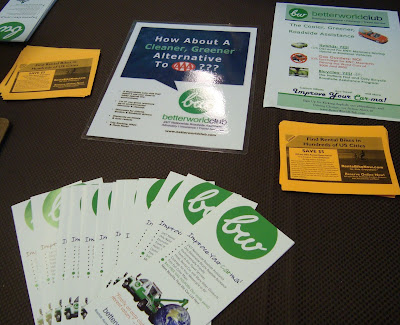
Better World disparages the environmental record of AAA -- in particular its refusal to support the Pavley bill in 2002, the first-in-the-nation law cutting tailpipe exhausts linked to global warming (it got caught up in battles at the federal level over the right of the EPA to regulate CO2 and the Bush administration's lingering refusal to acknowledge the science out there and admit that global warming was -- and is -- linked to human activity). BW also allocates one percent of its revenue to environmental cleanup and advocacy.
 Peace!
... and fresh vegetables ...

One of my favorite parts of the festival. For $5, you can get three tokens that can be used in exchange for samples of the wine ...
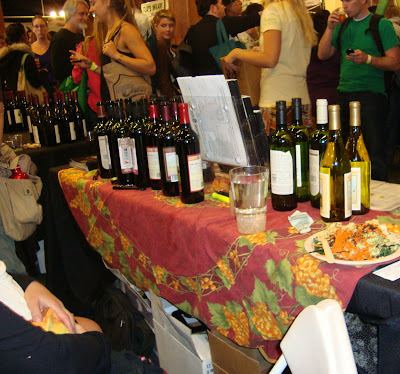
 The Merchandise, Global Exchange booth
 Green Dentristy?
These women are associated with the
Green Dentistry practice on Post Street in San Francisco. According to a brochure, the walls in their practice are made from "recycled sheetrock and acoustic insulation that was made from recycled denim jeans." Instead of x-rays, they use digital imaging technology to capture images of teeth, and they use bio-compatible fillings for cavities.
I had no idea ...
 Kijiji Grows, Urban Garden Systems
Kijiji
 Kijiji
 Our Mission ...
is a collaboration of farmers, artists, engineers, builders and educators who advocate for aquaponic gardening. Our mission is to bring aquaponics to the San Francisco Bay area and change lives through urban sustainable growing systems in schools, homes and businesses."

Joni Eisen, at it again ...
Joni volunteers for
Clean Money Campaign, and at the moment, this group is concentrating on getting the
California Fair Elections Act passed next year. It will be on the June 8, 2010 ballot. This is a public financing measure for candidates who agree to abide by some requirements on reporting and on who can contribute to their campaigns (like, no lobbyists, their clients, or anybody else. Yup, anybody else -- no private contributions at all).
 Park Merced?
How did these folks get in here?
Park Merced is strangely suburban development in San Francisco's southwest sector. I've never found it to be particularly compelling, but preservationists are apparently up in arms over plans that the owners and managers have for "major
redevelopment, which would involve demolishing the garden apartments in favor of higher density replacements, and reconfiguring the streets.
"
And its opposed by ordinary renters like myself because, right now, Park Merced rents are regulated according to our local rent control ordinances, and rent control provides our only abundant source of affordable housing in San Francisco. But when you demolish a rent-controlled unit or 50, by law whatever is built to replace that unit (or 50) will not be rent-controlled. The powers that be in San Francisco have been trying to drive out middle and low-income people for decades and decades. In response, members of the San Francisco Board of Supervisors passed rent control in 1979. Since then, the powers that be have done everything that they can to chip away at rent control -- and force people to move into the less expensive but habitat-destroying suburbs of the Central Valley and elsewhere.
So what's green about these exhibitors?
Well, according to their advertising the renovated complex (without rent control or with less of it) is going to be a
green utopia!

Hippie dudes with a sustainable printing operation.

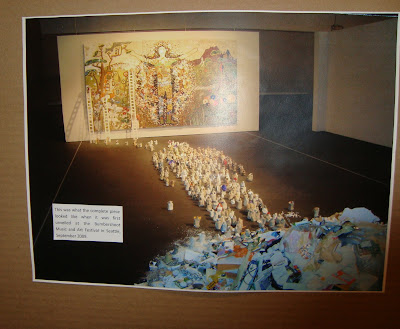
The human figures in this photograph are converging on a photograph of the art that was exhibited behind the speakers podium.
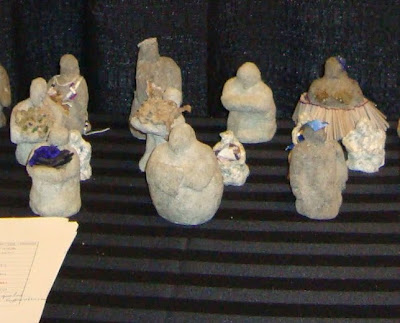 Miniature sculptures made from waste paper.
Artist
Ari Derfel saved his trash for an entire year and then turned it into this mural.

Up close, you can identify the bottle caps, scraps of paper, buttons, and so on. From a distance its a human figure emerging from a froth of garbage.
 The Plastic Bag Monster, of course ...
 Vegan delicacies ...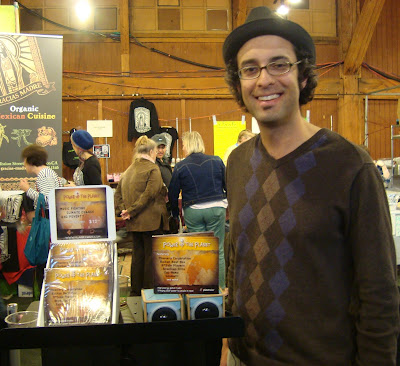
Dan Porras, founder of
Planetwize; Music, Media and Products That Create Change ...
Porras has been a musician all his life, but he got a masters degree in Ecological Economics at the London School of Economics. He is now working at what he calls "the intersection of sustainability, technology, and music." He works with musicians -- including Balkan Beat Box, Thievery Corporation, and Brazilian Girls -- to align their music with causes that they care about. A certain percentage of the profits from the sales of the CD that he was hawking at the festival, for example, will go to
Solar Aid, a British organization dedicated to bringing clean, renewable energy to the poorest people on the planet. In the past, Planetwize has also partnered with Farm Aid, Global Exchange, Oxfam America, Next Aid, and Rainforest Action Network, among other organizations.
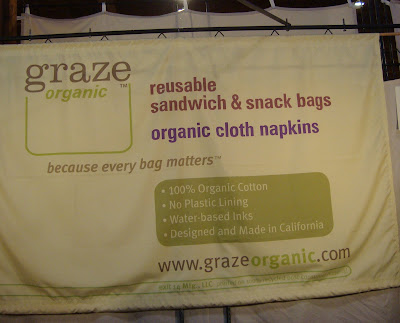
I didn't buy much, but I did stop here to get some organic cotton napkins for family members.

And I bought a notebook from Kevin Davis, pictured here, because he said he remembered me from last year. And because he said he would plant a tree in collaboration with the
Arbor Day Foundation for every notebook that he sold. Here, he's holding up a box of colored pencils. I bought boxes of these for my nieces and nephews last year. The pencils are not made from wood -- they are made from tightly rolled newspaper. His company is called
O'Bon, and if I remember correctly, the business is a family enterprise.
 The Final Word???
Individuals and groups that did not have booths inside hung around outside. Among them were Stephen Wilson and a group of 9/11 conspiracy theorists. Wilson told me that he is a commercial real estate consultant with three science degrees -- to lend his belief that 9/11 was an inside job some credibility.
"How can we create a green world and stop global warming if the people aren't even in control of their own government and are being lied to by their own government?" he asked.
"First you need the truth. Then you can identify effective solutions to the problem."
I personally don't think we have the whole truth about September 11, 2001. But I'm not waiting for the entire truth to be revealed to me before I start changing my own lifestyle to reduce my carbon footprint.